
11.08.2026
Shaken – Not Stirred
At the Velbert Testing Institute (PIV), there are often interesting test benches whose purpose isn’t immediately apparent. This is also the case with the so-called shaker, which—when it’s running—humming away in the corner, does its job. But what’s actually happening there?
Upon closer inspection, you can see a small test specimen vibrating continuously on the waist-high device, which measures approximately 1.5 by 2 meters. The correct name for this testing device is “electrodynamic vibration test system,” but it is commonly referred to as a “shaker” in technical jargon. The small test specimen is a mechatronic lock cylinder.
Tester Gregor Röhling, who has been working at PIV for 16 years, explains the application of various standards for mechatronic components: “Here, we conduct tests in accordance with the standard for mechatronic cylinders (DIN EN 15684) as well as the standards for mechatronic hardware (DIN EN 16867 and DIN EN 16864) and mechatronic padlocks (DIN EN 16864). The tests are designed to simulate the service life of the cylinder—that is, the vibration and shock loads to which lock cylinders may be exposed during transport, installation, and subsequent operation. Two different methods are used for this purpose. The goal is to ensure that the components remain stable throughout their entire service life.”
Increasing Vibrations
First, there is the sine wave sweep. During this test, the locking cylinder clamped into the apparatus is subjected to a frequency range of 10 to 150 hertz (Hz), with the frequency changing at a rate of one octave per minute. In the first step, one octave covers the range from 10 to 20 Hz; this is followed by an increase to 20 to 40 Hz, and in the next minute, a further increase in stages until 150 Hz is finally reached. The entire test lasts about 40 minutes. Although the shaker’s frequency range extends up to 4,500 Hz, this high frequency is not required for the test. The device is therefore capable of more if necessary.
The sine wave cycle is followed by the continuous shock test. This test involves an acceleration of 40 g. Here, “g” does not refer to grams, but to the acceleration due to gravity. 40 g corresponds to approximately 392 m/s², which is 40 times the normal acceleration due to gravity of 9.81 m/s². For comparison: Standing normally on Earth corresponds to 1 g, while a roller coaster ride corresponds to about 4 g. The sustained shock test involves ten times that amount.
These extremely powerful impacts simulate the stresses encountered in real-world use—for example, when a door is slammed shut with force or slams shut due to a draft. No one wants to get their fingers caught between the door and the frame. During the test, however, you don’t notice this force at all. The shaker hums stoically away, regularly vibrating its plate, which rests on a rubber membrane. The movement resembles a speaker cabinet pumping bass tones into the room.
After this test cycle, the shaker comes to a stop, and Gregor Röhling checks whether the lock cylinder can still be opened and closed. If it operates smoothly, the test is passed. This is the case after nearly all tests, demonstrating the high level of precision inherent in such a component—a feat that is rarely appreciated and often underestimated.
Image source: Quality Association for Locks and Hardware
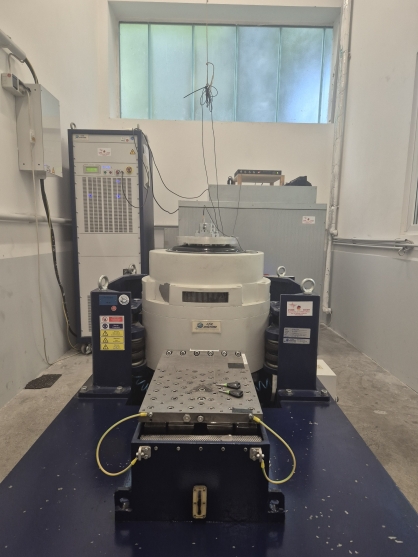
The test specimen is mounted on the platform of the waist-high shaker, which measures approximately 1.5 x 2 meters.
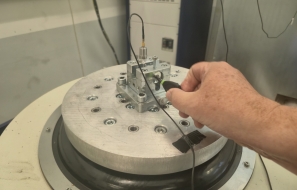
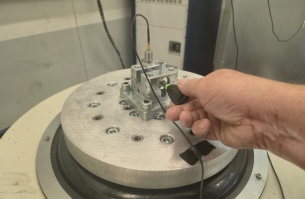
After this test cycle, the shaker comes to a stop, and a test is conducted to determine whether the lock cylinder can still be locked and unlocked.
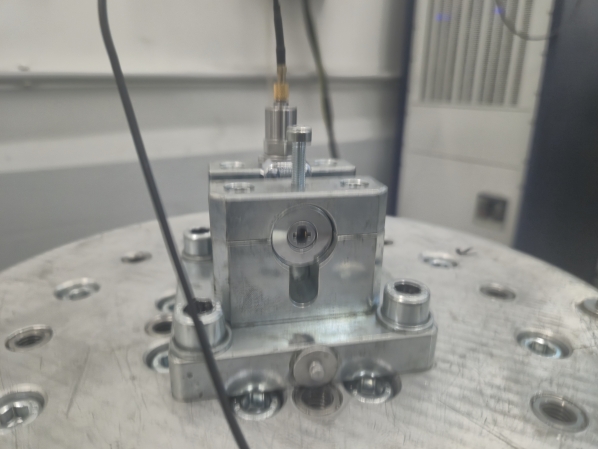
Note: The image is not blurry; it shows the shaker in action at 150 Hz in a sinusoidal cycle.