
14.07.2026
Air-tight or not? That is the question
When windows and doors are tested according to current standards, enormous forces act on the building components. The pressures generated during air permeability testing are high. The alternation between pressure and suction would be uncomfortably noticeable to us humans.
But a window or door must be able to withstand this, because otherwise manufacturers are not allowed to affix a CE mark to their product and thus cannot sell it in the EU. Such tests are conducted by the Schösser und Beschläge Velbert Testing Institute (PIV). These tests are conducted in accordance with the DIN EN 14351-1 standard, which has applied to the performance characteristics of windows and exterior doors since 2006, or in accordance with DIN EN 13830 for facades. The testing includes air permeability, driving rain resistance, and wind load tests.
Air Permeability Test
First, the test bench is prepared and the window unit is installed. Then the four-hour test begins. The functionality of the test specimen is checked beforehand: The window unit is opened and closed at least five times. This is followed by three pressure surges at maximum air pressure, which in this case is 660 pascals (Pa). This corresponds to nearly 120 km/h and thus reaches hurricane force.
Afterward, the actual test begins with a pressure increase in increments of 50 pascals. This corresponds to a light breeze of 35 km/h, which would cause tree branches to sway outdoors. For a window or door element, this should not be a problem. The pressure is gradually increased to 300 pascals. This is already equivalent to a storm with winds of just under 90 km/h, which can cause minor damage to the surrounding environment. To test market suitability, the pressure is increased from 300 Pa in 150-Pascal increments up to 600 Pascal. This value corresponds to a hurricane-force storm. The test is then repeated with negative pressure to create an equally strong suction force.
The standard defines four air permeability classes, with Class 4 being the highest. To achieve one of the specified classes, the measured air permeability must not exceed the upper limit at the test pressure for that class. Both the air permeability relative to the total surface area and that relative to the open joints are evaluated.
Driving Rain Tightness Test
The air permeability test is followed by the driving rain tightness test. First, the element is exposed to rain for 15 minutes without air pressure. If the previous hurricane-force storm had caused even minimal deformations, these would already become visible at this stage. However, according to Gregor Röhling, who has been conducting tests at PIV for 16 years, this hardly ever happens anymore.
Then the actual test begins with increasing air pressure—similar to the air permeability test—until 600 pascals are reached. However, even higher pressures can be tested upon customer request. The test stand is equipped with spray nozzles every 40 centimeters, each spraying two liters of water per minute. “That’s quite a deluge,” Röhling notes. During the test, the inspector monitors the panel for water leakage. Any abnormalities are documented.
Wind Load Test
If the element remains dry on the inside after the driving rain test, the manufacturer—who traditionally observes such a test—can breathe a sigh of relief for the time being. But the test is not over yet: Next comes the wind load test. This test checks whether the element deforms within acceptable limits. To do this, the tester attaches measuring probes to the test specimen. These probes measure whether the deformations during the test remain within the tolerance range. This is followed by three more pressure surges. The pressure level depends on the class being tested. Depending on the class (1 through 5), the pressure P1 is 400, 800, 1,200, 1,600, or 2,000 pascals. However, higher pressures can also be tested upon customer request.
The three pressure surges mentioned above are performed at a pressure of P1 + 10%. This is followed by a gradual pressure increase in 400 Pa increments up to P1 for the respective class, which is maintained for 30 seconds. The deflection is then measured.
One minute after the pressure is released, the deflection is tested again without wind load to detect any permanent deformation. The test is then repeated with negative pressure. In the second half of the test, 50 cycles are performed with alternating positive and negative pressure, each at half the P1 pressure.
The process concludes with a safety test: During this test, the component is subjected to 1.5 times the maximum pressure. It may deform more than specified in the standard, but must remain intact.
Next comes the evaluation: “We inspect the test component for damage or loose parts. We record all findings in the test report. Our software then analyzes all the collected data, and the customer receives the documentation, the test report, and, in most cases, the positive test result,” says Röhling.
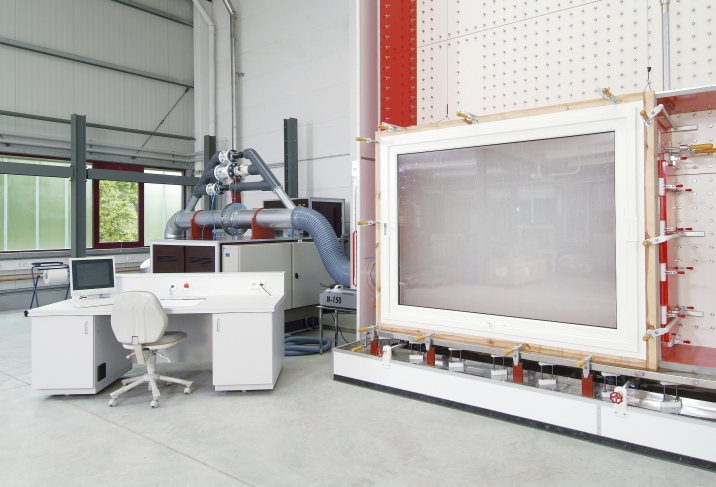
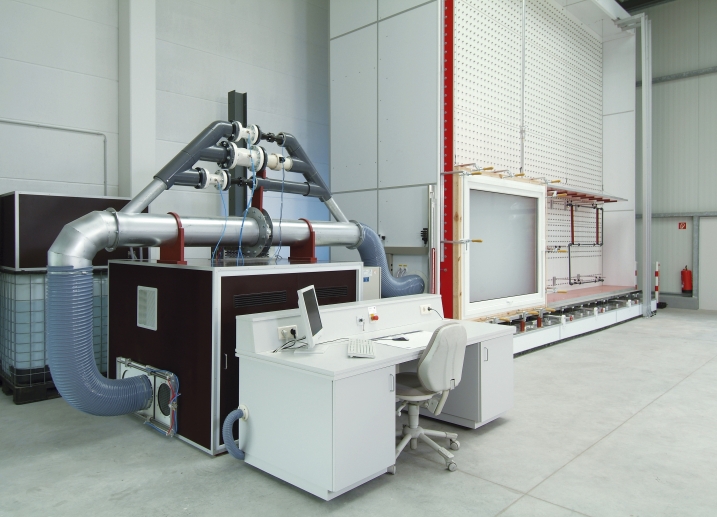
The PIV is one of the few institutes in Germany that has a test bench for window or door units.
Photos: Quality Association for Locks and Hardware
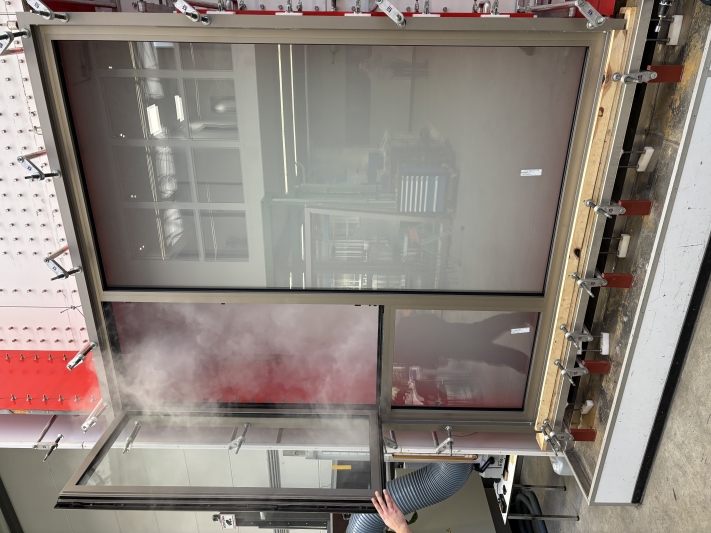
During this test, a window or door unit has to withstand quite a bit. Otherwise, manufacturers are not allowed to affix the CE mark to their product and are therefore not permitted to sell it in the EU.
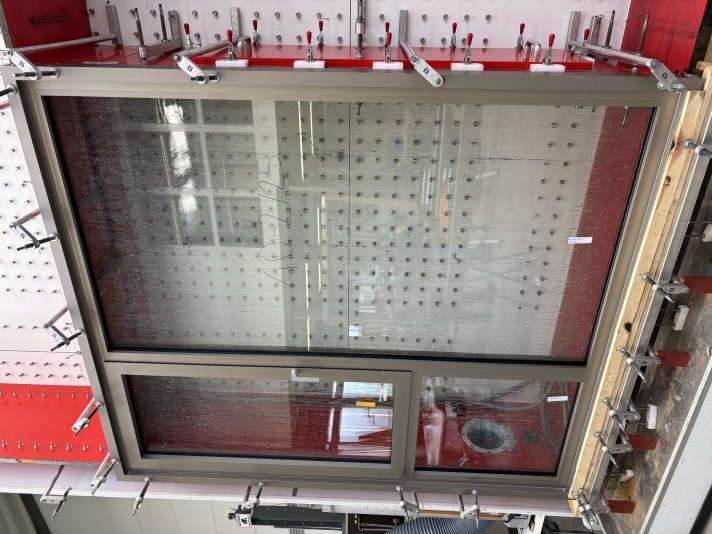
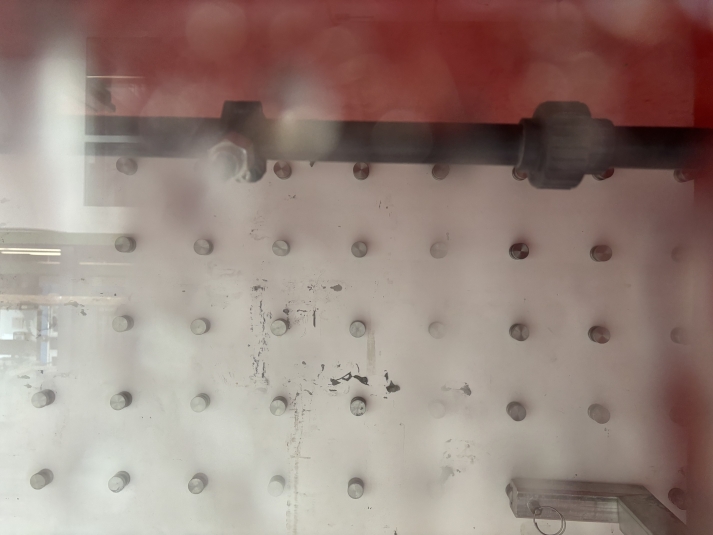
The test stand, which measures 5 by 6 meters, has a spray nozzle every 40 centimeters that can discharge 2 liters per minute.
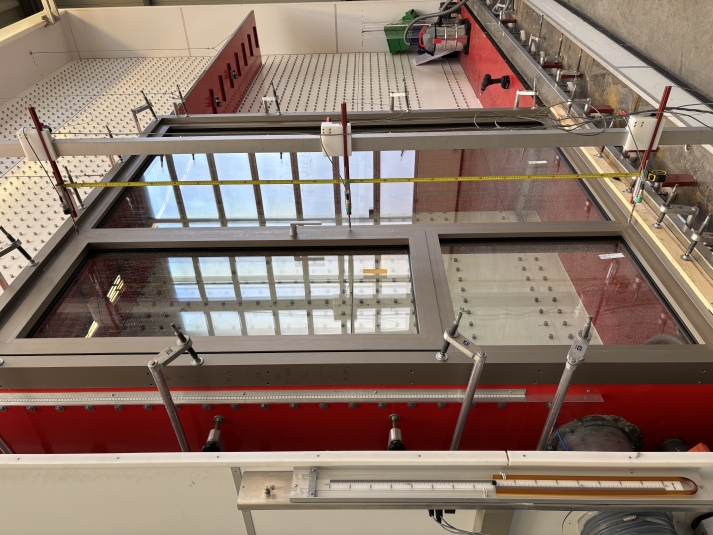
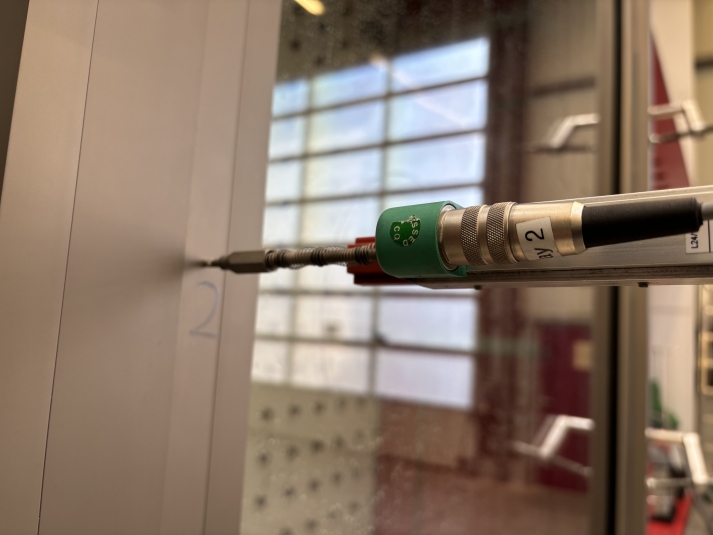
For the wind load test, sensors are attached to the test specimen. These measure whether the deflections during the test remain within the tolerance range.